


There is something so moving about the fact that even now, even with so much of the world feeling loud and sharp and apparently run by people who believe volume is a substitute for wisdom, there are still human beings sitting in camping chairs on a beach to protect tiny birds.
Not large birds, either, not some majestic eagle cutting through the sky like a national anthem with wings, but little terns, which are about as grand and imposing as a handful of feathers with opinions. They are the smallest terns in the UK, bright-billed and quick-footed, with the very unfortunate habit of laying their eggs in shallow scrapes in the sand, which is a beautiful idea if the only other creatures on earth are other terns, and an absolutely unhinged real estate decision if you remember that people, dogs, storms, predators, and the general chaos of existence are also involved.
Every spring, these tiny birds migrate from West Africa to the shores of Britain, arriving with all the fragile determination of something that has crossed more of the world than most of us ever will and still believes there is a place safe enough to begin again. At Lindisfarne National Nature Reserve in Northumberland, they come to nest among the dunes, saltmarsh, and wide open stretches of sand, where their eggs can be nearly impossible to see and their babies, when they hatch, look like the beach itself got a little nervous and started moving.
I can’t stop thinking about that. I can’t stop thinking about a creature small enough to be missed beneath an ordinary human step, flying thousands of miles because somewhere inside its little feathered body there is an ancient map, an instruction older than any of our worst ideas, telling it to return, to build, to trust the shore one more time. And I can’t stop thinking about the people who decided that this mattered.
At Lindisfarne, conservation workers and wardens have been trying to protect the birds from the kinds of threats that come not only from malice, but from our normal human obliviousness. People walk beaches because beaches are beautiful. Dogs run because dogs are dogs, and if there is one thing a dog will do with the confidence of a small-town mayor at a pancake breakfast, it is sprint joyfully through any environment that contains sand, smells, birds, or all three at once. Tourists wander, children explore, boots land where boots land, and sometimes life is crushed not because anyone meant to be cruel, but because no one knew it was there. That feels like a lesson worth holding onto.
So, the people at Lindisfarne made the invisible visible. They put up low netted fencing around the nesting areas, not to turn the beach into a fortress, but to give the birds a fighting chance. They hired seasonal wardens to sit near the nesting grounds and talk to visitors, explaining why certain patches of sand should be left alone, why dogs needed to be kept on leads, why a scrape in the ground might be the whole world to a bird who has traveled across continents to lay her eggs there. It is such a humble kind of hope, which might be why I love it so much.
Nobody needed to invent a miracle machine. Nobody needed to stand in front of a camera and announce that they alone could fix the birds, which I’m sure was disappointing to at least one man in a suit somewhere. They just needed fences, patience, funding, knowledge, and human beings willing to say, kindly but firmly, please walk over there instead, because there are babies here and because of that, the birds came back.
In 2020, only twenty-five pairs of little terns arrived on Lindisfarne’s shores, and only fifteen of those pairs produced fledglings. By 2025, one hundred thirty-eight pairs arrived, and together they produced two hundred one fledglings, which is the kind of number that makes my heart want to sit down for a minute and stare out a window like a woman in a period drama who has just received meaningful news.
Two hundred one fledglings. Two hundred one tiny, living answers to the question of whether small acts matter. Two hundred one bits of proof that a beach can be shared, that people can learn, that the world is not always too far gone to respond when we finally decide to be careful with it.
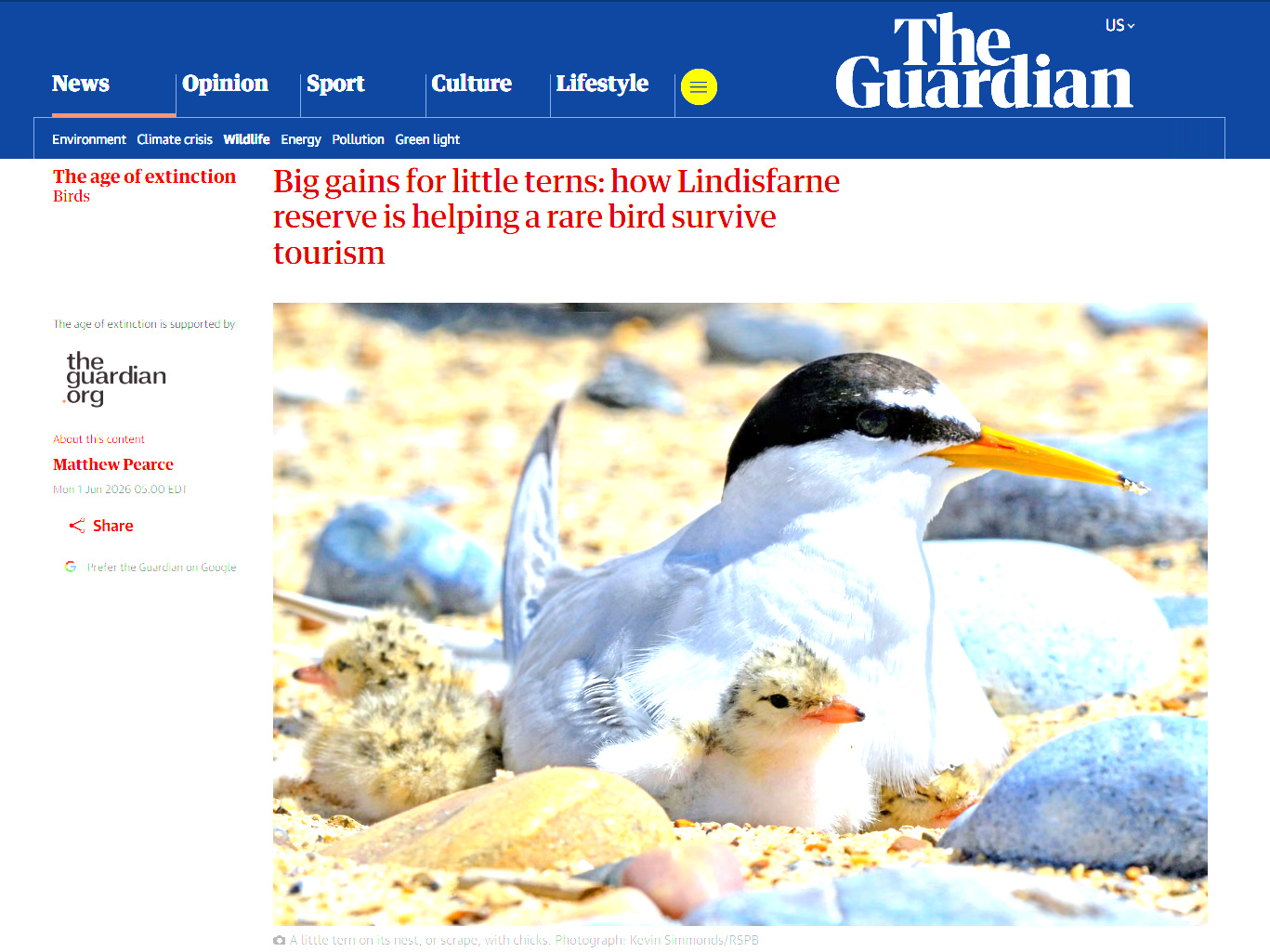
I think that is the part that stays with me most, because so much of modern life seems designed to convince us that care is either useless or embarrassing. We are told, in a thousand different ways, to toughen up, to get over it, to accept cruelty as realism and indifference as intelligence. We are told that the world is what it is, as if the world has not always been shaped by whatever we choose to notice, whatever we choose to protect, whatever we choose to walk around instead of through.
But then somewhere on a beach in Northumberland, a seasonal warden sits in a chair and explains little tern nesting behavior to a stranger with a dog, and the whole argument falls apart, because it does matter.
It matters when someone says, wait, there is life here, when someone builds a fence low enough for a bird to fly over and obvious enough for a human to respect, and when people who came to the beach for their own peace leave having learned how to make room for someone else’s survival.
And I keep thinking about how often hope looks exactly like that. Not a guarantee, or a grand and glittering rescue that arrives on schedule with a soundtrack and a functioning group text, because apparently that isn’t how life works, and I have filed a complaint with management. Hope is often smaller and stranger than that.
Hope is a scrape in the sand that somehow becomes a nest. Hope is a bird so small it could fit in your hands crossing oceans because its body remembers the way. Hope is a person explaining to another person that this patch of beach matters, and the other person listening. Hope is the decision to protect something delicate before it disappears.
Which is probably why this story hit me so hard this week, because on the home front, we are standing at the edge of our own small, fragile, unbelievable beginning.
On Tuesday, if all goes as planned, we are going to close on the house, and this little square in a small Oregon town will finally, truly belong to us.
I still don’t know how to write that sentence without wanting to cry, laugh, throw up, and immediately start apologizing to every appliance for all the things we are about to ask of it. After everything this year has held, after all the fear and uncertainty and the long nights spent trying to imagine how you pack up a life without breaking it, this place is still here. We are still here, the trees are still standing, the children are still running through the yard, the walls that have held our ordinary little miracles are not becoming someone else’s story, at least not yet, and maybe not for a very long time.
I don’t think I fully believed we would get here. I wanted to believe it, of course. I tried to believe it with the exhausted determination of a woman Googling mortgage terms at midnight while pretending she is not emotionally attached to every single doorknob in the house. I hoped, and I prayed, and I bargained with the universe in the deeply dignified way one does when one is both a mother and a person who has recently cried near a stack of laundry.
But hope, when you are afraid, can feel almost rude. It can feel like an uninvited guest showing up while you are trying to be practical, tapping you on the shoulder and whispering, what if this isn’t over yet. What if people come through, what if the door stays open, and what if the story you thought was ending is actually just waiting for the next paragraph. And now here we are, somehow, with closing day on the calendar and dirt under our fingernails.
My daughter and I have already planted strawberries and tomatoes, because apparently the women in this family respond to life-altering uncertainty by putting plants in the ground and hoping they don’t take our anxiety personally. Some of her strawberry plants are already starting to produce, and the look on her face when she saw them was something I will carry with me for the rest of my life.
There are moments in motherhood that feel too pure to touch directly, and this was one of them. Her little face lit up with wonder, the sacred kind, the kind that comes when a child realizes the world has kept one of its promises. We put something small in the dirt, we watered it, we watched it, we cared for it. And then, against all reasonable evidence provided by the evening news, something sweet appeared.
Now she reminds me constantly to water the plants and flowers, which means I have officially been promoted from mother to assistant groundskeeper under the supervision of a very small horticultural dictator. She is correct, to be clear, because the plants do need water, but she delivers these reminders with the urgency of someone personally responsible for the survival of agriculture. And honestly, it sounds like music to my ears.
The flowers are starting to look beautiful, the strawberries are coming in, the tomatoes are doing their best, and my husband is out there clearing brush, making a trail through the woods, and beginning the much-needed work of preparing the land for a mystical fairy garden. This is the kind of project that sounds whimsical until you realize it involves tools, sweat, Oregon vegetation, and at least one adult man taking instructions from children who believe fairies require both aesthetic consideration and adequate infrastructure.
To his credit, he is taking the assignment seriously. The kids are right alongside him, of course, because nothing says childhood like following your father into the woods while he clears a path for magic, and nothing says parenthood like trying to make something enchanted while also making sure nobody steps on a rake. Even Ezra is out there with them, coated in sunscreen and tucked safely into a pack n play at the edge of the action, standing there like a tiny foreman overseeing a woodland development project he has not legally approved but clearly intends to inherit.
He watches everything. He watches his siblings move through the trees. He watches his dad work. He watches the yard and the forest and the life happening just beyond his reach, and I can feel the ache of it sometimes, the way he wants to run with them, the way he wants to be part of every muddy, magical, mosquito-bitten inch of it.
On Friday, Ezra has his appointment, and from there we will find out the next steps and where we will be heading for his MRI. I am trying to hold that with as much courage as I can, though courage, as I have learned, is often less like bravery and more like making snacks while your heart quietly paces the floor. We don’t know everything yet, we’re still waiting, we’re still watching and measuring, and we’re still doing that terrible parental math where love and fear keep adding themselves together until you’re not sure how one body is supposed to hold it all.
But he is here. He is here in the sunlight, in his sunscreen, in his little safe square at the edge of the woods, watching his family prepare a place for him to run when the day comes. He is here while strawberries ripen and flowers bloom and his siblings help their dad make a path through the trees. He is here in the story with us, and whatever comes next, we will meet it together. That, too, is hope.
Not the clean, easy kind. Not the kind that arrives after everything has been fixed and says, see, wasn’t that simple, because no, it was not, and I would like that version of hope to stop gaslighting me immediately.
This is the muddy kind, the trembling kind, the kind that shows up while there is still paperwork to sign, appointments to attend, brush to clear, children to sunscreen, plants to water, and one very important fairy garden waiting for its zoning approval. This is the kind of hope that says the world can be cruel, but it is not only cruel.
I still can’t quite believe it. I can’t believe this little patch of old growth trees gets to remain part of our story. I can’t believe we get to keep waking up here, watering tomatoes here, building a fairy garden here, watching our children become themselves beneath these branches. I can’t believe how close we came to losing it, and I can’t believe how many people reached toward us anyway.
Maybe that is why the little terns feel like such a perfect reminder this week. Their nests are not grand, their eggs are not obvious, and their whole future is tucked into a scrape in the sand, vulnerable to weather and footsteps and all the careless momentum of the world. But when people finally notice, when they slow down, when they say this small life matters enough for us to change our path, the birds return, the fledglings rise, and the beach becomes a place of beginning again. And maybe that is the best proof we get that humanity is not lost.
Not because we always get it right, because good grief, we do not, and anyone with access to the internet knows we are very much a species in need of adult supervision. But because again and again, in places both wild and ordinary, people still choose care. People still learn to see what they once missed. People still build fences around fragile things, not to keep love out, but to give life enough room to grow.
So this week, I am thinking of tiny birds on a faraway shore and strawberries in my daughter’s hands. I am thinking of wardens on the beach and children in the woods. I am thinking of Ezra at the edge of the trees, watching the world that is waiting for him. I am thinking of this house, this land, this impossible mercy, this little square in Oregon that will soon, somehow, be ours, I am thinking about all of you that made all of this possible. And I am thinking that maybe hope is not always the thing that saves us all at once.
Maybe hope is the thing that asks us to be careful where we step, because there is life here, the thing that keeps returning across impossible distances, or the thing that looks at a patch of sand, or a patch of forest, or a patch of earth behind a small house in a small town, and says, yes, here too. Here, life can begin again.
P.S. Our guest contributor Jackson has a piece coming out tomorrow that I highly recommend everyone read. It’s about California condors, conservation, and what happens when people decide that even the creatures hovering at the edge of disappearance are worth fighting for.
So lovely from the tiny birds in Lindisfarne to your own happiness at seeing your children and strawberries. May all go well with the medical tests. You are a joy to read.
Thank you.