


There are weeks when the headlines feel like a fist, when the world seems to be run by people who talk about “options” and “leverage” the way you might talk about furniture, and the cost of those options is paid in bodies that never agreed to be a bargaining chip. This week, the news out of Iran has been full of that kind of language and that kind of grief, with reports of U.S. and Israeli strikes followed by retaliatory attacks, and even that a girls’ elementary school in Minab was hit, killing schoolchildren.
And then, in the same week, on the same planet, in the same species, there is a different kind of story, smaller and cleaner and stubbornly bright, like a candle somebody insists on shielding with their hands when the wind starts showing off.
On February 18 at Belmont Harbor in Chicago, the wind did what wind does when it gets a little too proud of itself, and it grabbed a stroller the way a bully grabs a hat, and it shoved an 8-month-old baby toward the water. A man nearby, Lio Cundiff, saw the stroller go and heard the scream that turns air into a siren, and he said, simply, “Her kid could’ve been gone,” because sometimes the plainest words are the truest ones.
He also said he does not even swim, which is the kind of detail that should make the whole story impossible, except that humans have a long tradition of doing the impossible when love is suddenly placed in front of them like a test they never studied for. He told ABC7 that he could tell the baby’s mother was “too panicked to do anything,” and in the way people talk when they are still trying to catch up with their own bravery, he remembered thinking, “I guess I’m jumping in,” and then, even more bluntly, “That baby was, I wasn’t going to let that baby die. That’s crazy.”
This is where the story starts to glow, because it is not only about one person becoming a headline, it is also about the way other people become a rope. In the Sun-Times account, Cundiff described himself out there in the water with the stroller and the baby, and the line lands like a vow made in midair: “I guess if this baby’s going down, then I’m going down with her.” That is not strategy; that is instinct. That is the body deciding that another body matters more than ego, comfort, and the animal math of self-preservation.
Someone threw him a jacket like it was a lifeline disguised as Chicago outerwear, and the whole moment has the kind of accidental comedy that real life always sneaks into the frame, because of course the universe would pick a Chicago Cubs jacket for a rescue scene, because of course the city would insist on branding even its miracles. Cundiff later said, “Him throwing that jacket down helped me so much,” and then admitted what hero stories usually edit out, which is uncertainty and shaking hands: “I did not know how long I was gonna be able to keep either of us afloat.”
On ABC7, he offered a detail that will make your stomach drop and then release, which is the emotional rhythm of every parent’s nightmare: “I’m just glad the stroller was up, not face down,” and, “The baby dipped under a couple times, but I was able to keep her up,” and then the sound that basically means the universe decided to give mercy today, “She was breathing and crying when we got her out.”
Later, from his hospital bed, he told CBS News Chicago about a moment that is so tender it almost feels too intimate for television, as if the camera accidentally filmed something sacred. He said that when he did not know how much longer he could hold on, “I just kind of grabbed her hand and just, like, rubbed her hand a little.” In a crisis where everything is physics and cold and panic, he reached for the oldest human technology we have, which is touch that says: you are here, I am here, we are not letting go.
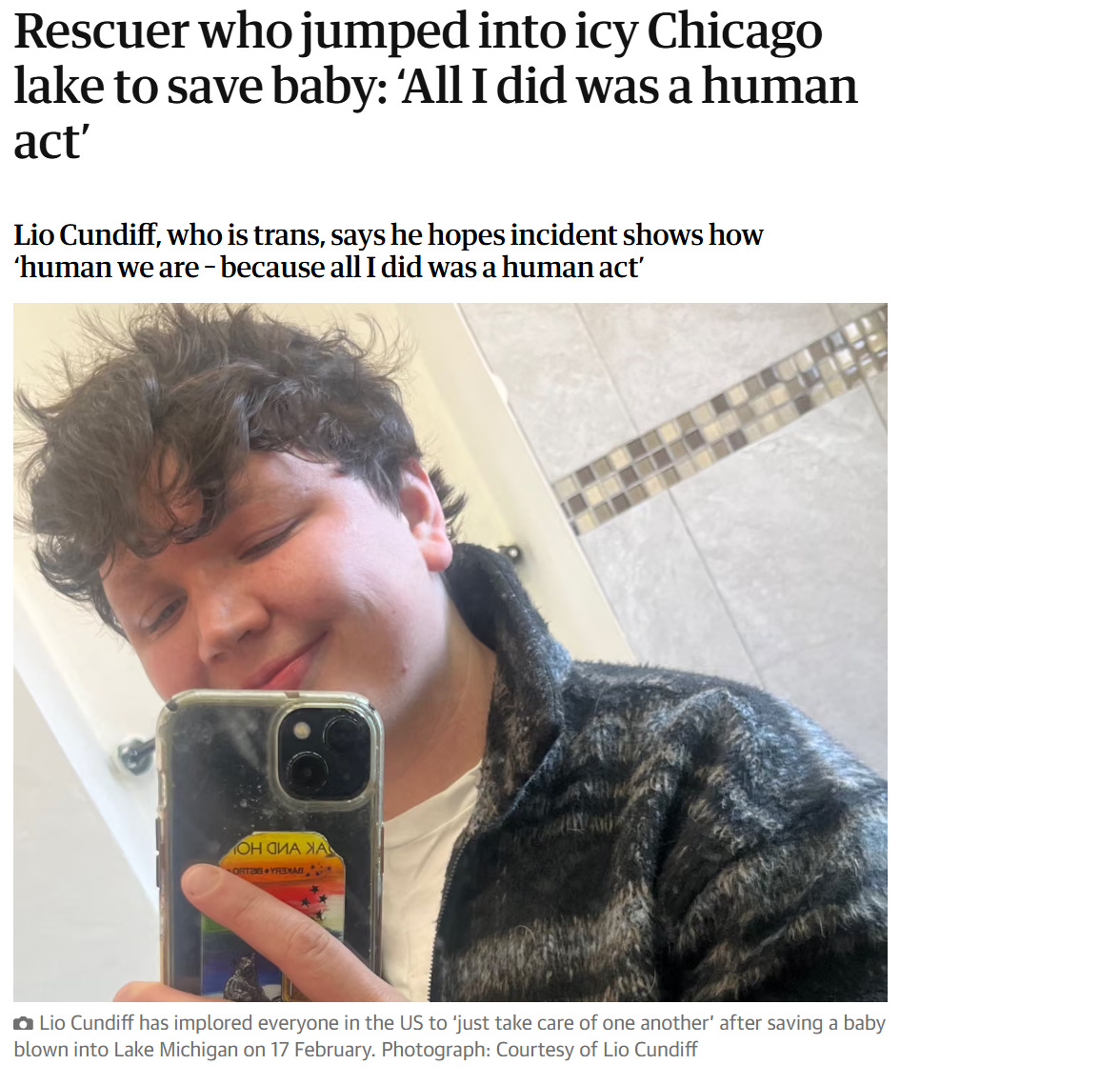
And because he is a stand-up comedian, because the world is strange and insists on contradictions, the story carries a little laugh inside the shaking. In the Sun-Times, he said, “Turns out if I have to choose fight or flight, I guess I’m a fighter,” which is funny in that soft way that humor is funny when it is also a confession. CBS captured a similar beat, the aftershock of adrenaline turning into a shrugging punchline: “Always thought I was a runner, I guess not today.”
What makes this story feel like hope, though, is not only that he did it, but that he refuses to turn it into a monument to himself. The Guardian quoted him saying, “All I did was a human act. I’m just a human who did the most human thing you could do, which is save someone who can’t save themselves,” and if you are looking for a thesis statement for the species, you could do worse than that.
This is the part where the contrast starts to ache, because in the same week that one person said he was “just a human,” the people who sit behind podiums and issue statements were also explaining violence in the polished language of necessity. The Associated Press published a transcript of Israel’s prime minister describing a joint campaign “in full cooperation” with “President Trump,” full of the grand vocabulary of operations and aims and resolve. Meanwhile, other reporting described civilian harm and escalating reprisals, including that schoolchildren died when a school was struck, which is the kind of sentence that makes your heart feel too small to hold what it has to hold.
I want to be careful with what we say out loud, because intent is a serious accusation and truth matters most when emotions run hottest. What we can say, grounded in the reporting, is that strikes are being discussed and executed at a scale where children can become collateral, and where a school day turns into a nightmare that families have to live inside. What we can also say, without needing to prove anyone’s soul in a courtroom, is that power has a way of making human beings feel abstract, as if the world is a chessboard and not a nursery.
And then, like a stubborn counterargument, you have Lio Cundiff at the water’s edge, not convening a meeting, not workshopping a statement, not asking what the optics are, just hearing a scream and letting his body answer it. He does not call it bravery, and he does not market it as virtue, and he does not even try to be cool about it, because in the moment he was not thinking about being a hero, he was thinking about a baby’s hand, and the fact that it was small, and the fact that it was there, and the fact that it should stay.
There is a line he gave ABC7 that feels like the kind of blessing you want to tuck into your pocket and carry around for the rest of your life: “I hope she has a really cool future, and I’m happy I was there.” A really cool future. Not a geopolitical future, not an ideological future, not a future that proves a point, just a future where a kid gets to be a kid, where she grows up and laughs at something dumb and eats cake at the wrong hour and tells a story one day about a time she does not remember, when strangers refused to let the lake have her.
If you are looking for hope right now, maybe it lives in that refusal. Maybe it lives in the fact that, even when leaders speak the language of force, ordinary people keep speaking the language of care, and sometimes they speak it with their whole bodies, leaping into freezing water without a plan, except the one that matters, which is that somebody has to bring the baby back.
Maybe there is hope for humanity yet, because humanity is not only the men in suits deciding what counts as acceptable loss, it is also the guy in a Cubs jacket throwing an armful of fabric toward a stranger, it is the mother and bystanders pulling together like a single muscle, it is a comedian saying he is “just a human,” and meaning it as both humility and instruction.
So yes, the world is loud with threats, and yes, the wind is still doing the most, and yes, the headlines will keep trying to convince you that cruelty is inevitable and that tenderness is naive. Still, there is a man on the Chicago lakefront who heard a scream and decided that a stranger’s baby was worth everything he had in him, and then he climbed out, shivering and alive, and said it was just what you do. And if that is not hope, then at least it is a map.
Thank you so much for sharing the story about Lio and the baby. As one who doesn't watch the news (I get information on line from a variety of sources, including you), I had missed it! Quite profound!
Our species’ DNA was his guide vs the pointless murder of school children.