


Good morning! This Thanksgiving, a president sat down in front of a camera and recorded a message for the American people. He began by wishing Americans everywhere a happy Thanksgiving, then thanked us for caring and for “having such good hearts.” He spoke of the simple things that any family wants: to come together in peace, to feel the warmth of being with loved ones, to celebrate their children’s achievements and thank their parents. Ordinary things, the kind many of us were fortunate enough to do yesterday without a second thought.
It was gracious, humble and warm in a way that’s become unfamiliar. It sounded like someone who understood what the holiday is for.
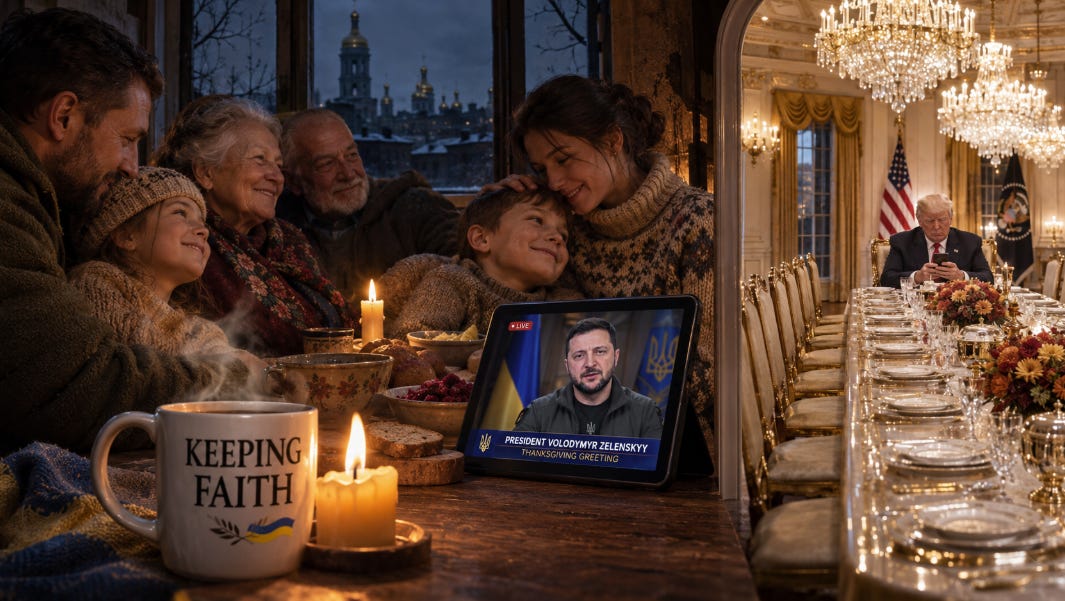
The man who delivered it was Volodymyr Zelenskyy.
The night before Thanksgiving, Russian missiles struck a shopping center in his capital. When he spoke of families gathering in peace, he was describing something millions of Ukrainians couldn’t do this week.
Thanksgiving is ordinarily an occasion to reflect upon what we have, whom we love and what we owe one another. Our own president marked it differently. His message was about who owes Donald Trump.
Trump posted his longer Thanksgiving greeting at 7:45 a.m. Pacific time.
It started out normally enough, with holiday wishes to the “American patriots” who have worked to make the country great. Then it turned into a roll call of everyone who has wronged him, each wished a happy Thanksgiving in the tone a Southern aunt uses for “bless your heart.”
First were the people who “issued fake Economic Numbers, just prior to the Election.” His complaint is that the Bureau of Economic Analysis first estimated third-quarter growth at 3.4 percent, then raised it to 4.3 percent on Wednesday, three weeks too late to help at the polls. He called it “A RECORD SETTING ERROR” and demanded an investigation.
A few details get in the way of the conspiracy. The revision came out precisely when BEA said it would, in a publication schedule released nine months ago. Revising estimates is how GDP reporting works, and the agency attributed this revision primarily to updated investment and consumer spending data. And BEA sits inside his own Commerce Department. The President of the United States wants his administration investigated for underestimating how well he’s doing.
Next came Minnesota’s Somalis. Trump thanked “the 2% of our Somalian population that have a job” without receiving government assistance and said the others should be “thrown out, immediately.” Census data puts labor force participation among Somali Minnesotans at about 72 percent, higher than the state as a whole. Earlier this year he claimed 92 percent of them weren’t working. Having a job is no longer sufficient. One must also forgo government assistance to qualify for the president’s Thanksgiving greetings. He also put “citizens” in scare quotes, as though American citizenship were a distinction he could personally confer or withdraw.
Then the White House, which he says went uncared for “for years” until he took time out of his “very busy schedule” to fix 17 broken windows and “chipped and decaying columns.” The building he says was “built in 1792” had its cornerstone laid that year. John Adams took up residence in 1800. The building was burned by the British in 1814 and gutted and rebuilt under Truman. As for the decaying columns, when the scaffolding went up this summer, his own staff called it “standard restoration work.” The ballroom, he added, is something presidents have wanted for 150 years. None of them, thankfully, thought to knock down the East Wing.
He closed by thanking the “murderers, drug dealers, and criminals” his administration has deported, wishing them “a beautiful and idyllic life” in “Faraway Lands.” “We miss you dearly,” he wrote, “but you will never be back.” Along the way he also worked in Sharia courts and property redistribution, because it wouldn’t be a holiday without them.
Once again, I find myself envious of the Ukrainian people for the grace and sincerity of the man who leads them. How lovely it would be to hear my own president speak and feel a sense of pride.
Later that day, when asked about Netanyahu and Israel’s next government, Trump described a country whose air force and navy had been “wiped out.” He seemed to mean Iran, though it was hard to tell whether he’d mixed up the two countries or just changed the subject.
Nor was there much reassurance to be found in the remarks of one of the men entrusted with conducting American diplomacy.
The day before Thanksgiving, Politico published a rare interview with Jared Kushner, the president’s son-in-law and one of his two envoys to the Kremlin. Kushner called Vladimir Putin “a grandmaster of politics” and “a historic figure” who “wants peace.” He gave Putin credit for showing “restraint” by not using nuclear weapons on Ukraine, called European military aid to Kyiv a “proxy war,” and described Putin’s envoy Kirill Dmitriev as “an incredible friend.” Zelenskyy, he suggested, ought to show Trump more respect.
If not dropping a nuclear bomb is the benchmark for restraint, every American president since Truman qualifies. It is a remarkably undemanding standard by which to assess the humanitarian conduct of a world leader.
Ukrainian officials privately describe Kushner to the Kyiv Independent as an engaged negotiator who brings new ideas to the table. But being invested in reaching an agreement is not the same thing as being discerning about the person with whom you are negotiating.
Kushner attributed a setback in peace negotiations last winter to an alleged Ukrainian attack on Putin’s residence at Valdai. The CIA reportedly concluded that Ukraine had not targeted the residence, and its director, John Ratcliffe, briefed Trump personally. “We don’t believe that happened now that we’ve been able to check,” Trump told reporters in January. Eleven months later, his son-in-law is still repeating the Kremlin’s version.
The grandmaster’s record deserves a look. Putin launched his full-scale invasion of Ukraine in 2022, apparently expecting a quick victory. Nearly five years later, Russian oil refining output has fallen dramatically since the end of October, according to Reuters, and Ukraine reports that a section of Putin’s prized Kerch Bridge has fallen into the sea. In April, the chairman of the Joint Chiefs confirmed to Congress that Russia was aiding Iran in its war against the United States. For a man who supposedly wants a better relationship with America, he has an odd way of showing it.
As for wanting peace, Russian attacks killed at least 10 people across Ukraine in the 24-hour period spanning Kushner’s interview and Thanksgiving morning.
Shaun Pinner had a particularly pointed reaction to the interview. He’s a British veteran who fought with Ukraine’s marines, was captured by Russian forces and sentenced to death, and was freed in a prisoner exchange. He’s back in Ukraine now, about two hours from the front. He told LBC’s Andrew Marr that the hairs on the back of his neck stood up when he heard Kushner praise Putin. On November 3, Pinner had witnessed the destruction of a power station in Dnipro.
He described what Russia is doing this winter: weaponizing the cold by destroying the infrastructure upon which elderly people, children, hospital patients and families depend for heat, medical treatment and a warm meal.
Last month, a UN Commission of Inquiry concluded that Russia’s systematic attacks on Ukraine’s energy infrastructure constitute war crimes and crimes against humanity.
Pinner’s message to Washington was simple. Ukrainians will keep fighting because they have no other choice.
And yet Zelenskyy doesn’t cast Ukrainians as passive recipients of American generosity. He hopes that “our courage and our love of freedom will always give strength to you.” There is dignity in that reciprocity.
But it requires keeping faith. Ukrainians are keeping theirs, at the front and in apartment blocks without heat. Whether we are keeping ours is a question Congress ought to be asking of this administration.
In fairness, Congress did try.
In August, the Senate passed the Lindsey O. Graham Sanctioning Russia and Iran Act 86 to 11. The House followed in September, 262 to 159. Trump signed it on September 18, and Zelenskyy thanked him.
Three weeks later, his administration licensed the importation of Russian diesel. A week after that, Trump signed an executive order waiving virtually all of the law’s Russia provisions, invoking authority Congress itself had given him. His administration maintained that imposing the sanctions would impede peace negotiations. A law passed by large majorities in both chambers was effectively gutted with one signature, two days before its major sanctions were due to take effect. Several senators objected, but Congress has yet to reclaim the authority it surrendered.
The Iran war tells much the same story. The Constitution gives Congress the power to declare war, and Congress never declared this one. The House has twice voted to withdraw American forces from hostilities. In June, the Senate agreed to a House resolution directing their withdrawal, only to reject a procedural motion the following day on a separate resolution that could have become binding law if enacted. Neither the passage of a resolution by both chambers nor subsequent congressional efforts have compelled the president to end the war. Meanwhile, the administration has requested another $67 billion in defense funding, much of it related to the war and the replenishment of depleted military stocks.
On November 3, voters gave Democrats both chambers, and the Iran war figured prominently in the election. But the new Congress isn’t seated until January 3. Until then, the outgoing Congress has a December 11 funding deadline, a defense bill and a farm bill on its plate.
That funding deadline is not merely another item on the legislative calendar. It is an opportunity to exercise constitutional authority. The Washington Post reported Monday that Senate Appropriations Committee Chair Susan Collins is exploring an agreement with Democrats that would replenish depleted military stocks while withholding funds for continued offensive operations against Iran without congressional authorization.
Congress still possesses the power of the purse. Whether it chooses to exercise it is another matter.
For another five weeks, responsibility rests with the sitting Congress. Five weeks is a relatively short interval on a legislative calendar. It is considerably longer when you are spending winter in a Ukrainian apartment without reliable heat.
After that, the question goes to a new Congress, which will have to decide whether it means to be a coequal branch or just a louder one. Oversight hearings would be a start. Revisiting the waiver authority that allowed a president to effectively gut a sanctions law he had just signed would be better. And there are questions about the conduct of American diplomacy that deserve answers.
Has the intelligence community revised its assessment of the alleged attack on Putin’s residence, or is an American peace negotiator disregarding American intelligence? What restrictions have been imposed on Ukraine’s ability to defend itself, who authorized them, and on what grounds?
Oversight is governing. It is not an extracurricular activity to be undertaken when the legislative calendar permits.
Zelenskyy ended his message hoping that Ukraine’s courage and love of freedom would give strength to us. It’s a generous wish. Whether we make good use of that strength depends less on what Trump posts on Thanksgiving morning than on whether the people we elected to check him remember that they can.
On a happier note, Marz is snoozing off a tryptophan hangover, having partaken of several generous helpings from yesterday’s feast. The grandkids delighted in leaping from one piece of furniture to the next, although the furniture may never be quite the same. All in all, it was a joyous, song-filled and thoroughly wonderful day.
I hope yours was, too.
Always a delight. Zelensky for President!
Dramatically striking contrasts at this holiday time … Zelenskyy, Carney and Obama show that strong yet humane leadership CAN prevail and energize. Trump is as admirable as his fake golden sconces.