


For nearly five years, the identity of the Jan. 5 pipe bomber sat like a ghost in America’s political attic, a black-hooded specter gliding through low-resolution surveillance footage, forever out of reach, forever feeding the country’s worst conspiracy theorists and its most exhausted investigators. The FBI released enhanced clips, offered bigger rewards, drew height estimates down to the inch, even analyzed the gold swoosh on a pair of Nike Air Max Speed Turf sneakers. And still: nothing. Just a nation waiting for the other pipe to drop.
Until this week. The FBI now says it has arrested a suspect: Brian Cole Jr., 30, of northern Virginia, charged with transporting an explosive device and attempted malicious destruction. The bombs he allegedly planted outside the DNC and RNC headquarters were not theatrical props or some half-baked political prank. They were viable explosives, placed in the quiet of night and discovered the next afternoon, at a moment when Kamala Harris was inside the DNC building, entirely unaware that someone had left a device outside capable of killing her and anyone else unlucky enough to be near it.
And before anyone starts drafting their “Actually, both parties were targeted, so this wasn’t political” think pieces, remember: targeting both parties is the oldest political motive. It’s called attacking the state.
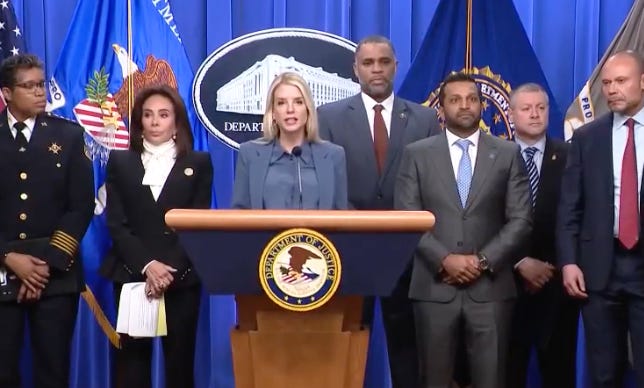
What’s shocking beyond the arrest itself is how it came about. Attorney General Pam Bondi, who has spent the past year turning the Department of Justice into a sort of legal reeducation center for Trump loyalists, announced that investigators found their man not through tips, public cooperation, or some sudden rupture in the suspect’s conscience, but by “sifting through evidence that had been sitting at the FBI.” She said it as if it were a compliment, but the phrasing felt more like someone stepping over a body while admiring the carpet. Five years of evidence sitting quietly on a shelf, apparently waiting for the right political environment to be considered useful.
Then came FBI Deputy Director Dan Bongino, who celebrated the arrest with the kind of chest-thumping rhetoric you’d expect from someone who used to get paid to say things like this on television. He insisted he alone created the multi-agency team that cracked the case, emphasized that the Biden administration “focused on other things,” and basically congratulated himself for refusing to let a pipe bomber “walk off into the sunset.” It was unclear whether Bongino understood that he was describing precisely what happened for four years, or that he was bragging about solving a crime his own boss had spent the past year pretending never really happened.
While Bondi and Bongino were busy casting themselves as co-protagonists in a triumphant law-and-order reboot, Harry Litman, former federal prosecutor and one of the few legal analysts left who can form a full sentence without an immunity deal, offered a sharp, almost sorrowful contrast. Yes, the arrest is a triumph, he said. Yes, it reflects the kind of tenacious, monastic dedication federal agents are still capable of despite being slandered as “deep state traitors” by the same people now trying to take a bow for their work. Litman praised the agents for sticking with the investigation through years of dead ends and blank walls. He reminded us that this is what real law enforcement looks like: slow, relentless, and allergic to political theater.
And then he turned the mirror on the Republican Party and, more specifically, on the man whose name looms over every compromised institution in Washington.
The timing here is not some neutral curiosity. The arrest of an alleged political bomber lands in the middle of a Republican-led attempt to rewrite January 6 as a sort of patriotic renaissance fair, complete with pardons, cosplay, and the occasional flagpole beating. Donald Trump, reborn as the world’s most confused historian, has been handing out pardons to violent Jan. 6 offenders with the breezy abandon of a game show host distributing oven mitts. Officers beaten with chemical spray? Pardoned. Rioters with stun guns and flag poles? Pardoned. People who literally breached the seat of government while chanting death threats? Pardoned.
And yet here stands Brian Cole, if he is indeed the right man, suddenly presented as something fundamentally different. A bridge too far. A line Trump will not cross. A crime he will not preemptively pardon. Litman asks the obvious question: why? What distinguishes this alleged bomber from the violent mob Trump has already absolved?
Nothing, except that Cole appears not to be one of “Trump’s people.” What we’re seeing is not a theory of justice but a theory of loyalty. Violence against the democratic system is acceptable, even laudable, so long as its practitioners show sufficient devotion to the man currently dismantling the system. Violence without devotion, however, is simply rude.
Congressional arsonists like Rep. Barry Loudermilk, who spent years flogging conspiracy theories about how the pipe bombs were planted by anti-Trump operatives, the deep state, Antifa, a rogue Capitol Police officer, choose your own adventure, suddenly find themselves in the awkward position of having to praise the FBI they tried to discredit while still keeping the conspiratorial machinery running. Loudermilk says the Bureau is “confident” they’ve got the right guy, but worries about what information Congress will or won’t be given. It’s the political equivalent of saying, “I accept the results of the election, but only because I’m being polite.”
The neighbors in Woodbridge, Virginia, where Cole lived, told reporters they had no idea anything nefarious was happening. One described the block as “Sleepytown,” which feels a bit too on-the-nose for a community that just discovered it was sharing a trash pickup schedule with the alleged Jan. 6 pipe bomber. High school classmates, social media histories, old employers, all of it will be exhumed now, because that’s what happens when a faceless villain suddenly has a face.
That, Litman argues, is the larger shift: the crime is no longer a blurry figure in a hoodie. It is a person, a motive, a trajectory, and those details eliminate the political cover that fog and speculation once provided. The conspiracies collapse under the weight of a name.
But there’s something else this arrest does. It spotlights the moral rot at the heart of the ongoing Jan. 6 revisionism. Because if Cole is guilty, he is not an aberration. He is an extension of the same destructive ecosystem Trump cultivated when he told supporters “it’s going to be wild,” when he urged armed followers toward the Capitol, when he tried to stop magnetometer screenings, and when he spat out pardons like sunflower seeds to those who carried out violence in his name.
And so the question hangs there: if Trump pardoned the people who beat officers defending democracy, what exactly makes a pipe bomb on the doorstep of democracy so different? The answer, depressingly, is simple. Nothing, except that Cole wasn’t part of the brand.
This is the America of 2025: agents in the field quietly preserving the remnants of a system while officials at the podium insist the system was never attacked in the first place. A bomber arrested, a mob absolved, and a president who sees no contradiction because contradiction requires principles, and principles require something sturdier than grievance.
Five years after two pipe bombs nearly changed the course of American democracy, we finally have a suspect. What we still don’t have is a government willing to confront the truth about the people who tried to destroy it.
If Brian Cole becomes the face of the crime, Donald Trump remains the face of the excuse. And that, as Litman would say with considerably more restraint than I can muster, is the real scandal.
Mary Geddry I hope you're compiling all your letters/essays into book form. They'll be very useful for history teachers in the coming years.
of course, we know know he was a classic part of the brand. His lawyer is now claiming that he has ALREADY been pardoned because of the broadness of the J6 pardon.