


Good morning! John Falchetto was a survivor. When rockets tore into his river gunboat in Vietnam, he was the only man aboard who made it out alive.
This February, just past his 80th birthday, he arrived at the VA hospital in East Orange, New Jersey, after days of stomach pain. A CT scan suggested his appendix had burst and turned gangrenous. Doctors wrote that he needed surgery immediately.
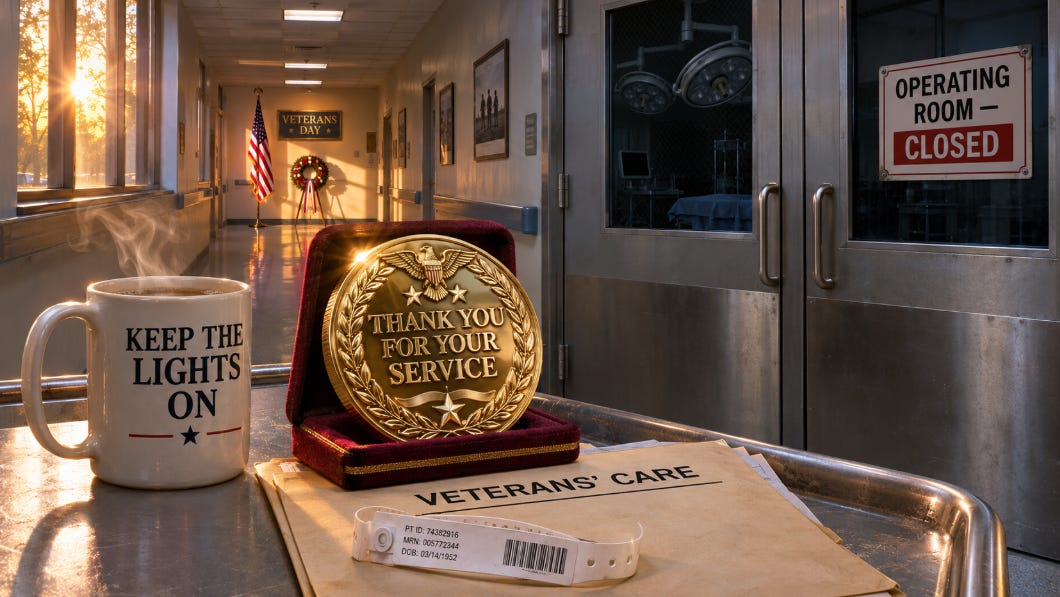
The hospital’s operating room was out of service. Instead of arranging an emergency transfer, administrators scheduled him for the morning transport shift. By the time he reached the Manhattan VA, roughly 12 hours had passed since he arrived at East Orange. Surgeons operated immediately and found sepsis. He died on March 7.
No one can say for certain that faster surgery would have saved him, and ProPublica, which reported his story this morning, is careful not to. What the reporting does establish is that he needed emergency surgery, his hospital couldn’t provide it, and his transfer was delayed until morning.
A few hours after that story went up, the president and vice president stood at Arlington National Cemetery to honor the nation’s veterans. Vance encouraged them to celebrate and have a good time.
Veterans Day honors the living, and veterans have earned a good time. The government’s ongoing obligation is to give them something more substantial than speeches to celebrate.
Early in Trump’s second term, the administration floated mass layoffs at the VA, then backed off after veterans’ groups objected. What followed, according to ProPublica’s reporting, was quieter: canceled union contracts, a rigid return-to-office order that overwhelmed a 70-year-old hospital’s physical capacity, DOGE’s weekly what-did-you-accomplish emails, and buyouts for employees willing to leave. Front-line medical staff were supposedly protected. Many left anyway, and many were never replaced.
East Orange and its affiliated New Jersey facilities lost nearly a tenth of their staff. The number of roles with severe shortages roughly tripled, from about 30 to about 90, a list that reads like a hospital’s org chart: oncologists, surgeons, anesthesiologists, nurses, mechanics, cleaners.
In 2023, before he ran the Office of Management and Budget, Russell Vought said he wanted federal workers “in trauma.” Nobody has shown that anyone drew up a plan specifically for East Orange, but the hospital looks a great deal like the workplace Vought described. And as the VA loses the staff needed to provide care directly, more veterans are being routed into the private Community Care system that conservatives have spent decades advocating expanding.
By May, the VA had roughly 5,100 fewer doctors, nurses and other mission-critical employees than when Trump returned to office. That month, VA Secretary Doug Collins told Congress there was nothing hospitals couldn’t hire. If they needed a doctor, he said, they could hire one. Soon afterward, Collins quietly imposed staffing caps.
Hospitals can hire anyone they need, apparently, except the people they’re not allowed to hire.
Meanwhile, the department had gone more than a year without using authority Congress granted, with bipartisan support, to pay highly qualified specialists above the usual government salary limits. At a time when hospitals were losing experienced physicians, the VA was leaving an available recruiting tool unused.
Dennis, a 72-year-old Vietnam veteran with advanced colorectal cancer, needed radiation to ease his bleeding and pain. East Orange had stopped offering it after the medical physicist responsible for calibrating its equipment quit. Dennis was referred to Community Care, which was itself overwhelmed and understaffed. His doctors flagged his case as urgent at least five times. His consultation was scheduled for September 12. He died on September 4.
ProPublica doesn’t claim the delay killed him. Oncologists consulted by the reporters said it almost certainly made his final weeks more painful.
The VA insists care has improved, citing record appointment numbers and measures on which East Orange outperforms private hospitals. It cited privacy rules in declining to discuss individual patients but also failed to answer ProPublica’s questions about broader operational problems, including the operating-room closures.
In late August, Collins visited a VA campus near East Orange. He spent little time with veterans in the residential PTSD unit. On his way out, he stopped to speak with Willie Johnson, a veteran who had lost both legs, thanked him for his service and handed him a commemorative coin bearing the secretary’s own name. Johnson told ProPublica that care had changed since Trump returned to office, and that even the food had gotten worse.
The next day, administrators praised the visit and the distribution of commemorative coins in a staff email. One recipient ran the maintenance department that had struggled to keep the operating room functioning. Last week, a backup generator failed, and the operating room closed again.
A commemorative coin is not an operating room.
That’s how we’re caring for veterans after they come home. Now consider what we’re asking of the men and women still serving.
On September 2, 2025, a U.S. strike on an alleged drug boat in the Caribbean left two survivors clinging to the wreckage. A second strike killed them. The Washington Post reported that Pete Hegseth had given a spoken directive beforehand to kill everyone aboard, which he denies.
The justification has shifted ever since. Defense officials suggested the men were radioing for backup. Then Adm. Frank Bradley, who ordered the second strike, told lawmakers they were in no position to make a distress call. What remained was the argument that the wreckage was still afloat with cocaine aboard. Rep. Jim Himes, who saw the video, described two unarmed men clinging to what looked like flotsam.
On October 16, another strike left two survivors. This time, American forces rescued them. The military demonstrated that surviving a strike did not necessarily mean receiving another missile.
Whatever those two men were carrying, they were human beings clinging to wreckage. International law requires feasible efforts to rescue people in distress at sea, not another missile directed at them. Their deaths also matter to the Americans who carried out the order.
The VA’s own National Center for PTSD recognizes moral injury: the lasting damage that can follow acts that violate a person’s deepest beliefs, or betrayal by those in charge. I can’t tell you whether anyone involved on September 2 carries that wound. But the administration authorizing these military operations is the same one whose policies, according to ProPublica’s investigation, are weakening the VA healthcare system those troops may one day need.
In 2016, as a Fox News commentator, Hegseth called Trump an “armchair tough guy” who was all bluster, and said the military won’t follow unlawful orders from its commander-in-chief. As secretary, he threatened to recall Sen. Mark Kelly to active duty, investigated him, and ultimately censured him and sought to reduce his retired rank after Kelly appeared in a video reminding service members of essentially the same thing. The 2016 Hegseth would make a fine witness against the 2026 one.
John Ullyot, Hegseth’s former Pentagon spokesman and a longtime Trump loyalist, says Hegseth makes the job about himself rather than the troops. Ullyot’s complaint is that the president deserves better. Fair enough, though the president isn’t the one waiting on a surgery.
At his news conference before Tuesday’s vote, Hegseth cast the impeachment effort as an attack on the troops. Hegseth isn’t standing up for the troops. He’s standing behind them.
Rep. Thomas Massie, a Kentucky Republican on his way out after Trump helped beat him in a primary, filed eight articles of impeachment against Hegseth. They cover war powers violations, a strike on an Iranian elementary school that killed at least 156 civilians, including more than 120 children, retaliation against Kelly, and the boat strikes, which have killed 243 people and which the articles call extrajudicial. Hegseth dismisses the charges as partisan policy disagreements, not impeachable offenses. But they are allegations of serious misconduct, and determining whether they warrant impeachment is part of the House’s constitutional responsibility.
On Tuesday, it declined to. The House voted 211 to 204 to send the articles to the Judiciary Committee, effectively shelving them for the rest of this Congress. Massie was the only Republican to oppose it. Every Democrat present voted to keep the effort alive.
Eleven Democrats weren’t present. Seven Republicans were absent too, but the Democratic absences were the ones that mattered: seven more votes against the referral would have tied it, and a tie kills the motion. Some of the absent Democrats were reportedly stuck in traffic on their way back from an event. Others had a medical procedure or a personal emergency. Nancy Pelosi was in San Francisco at a Veterans Day celebration, which is its own kind of irony. Democrats argue Republicans would have simply held the vote open until their own stragglers arrived. Maybe so. Showing up is still the minimum.
Trump celebrated on Truth Social that the Democrats’ impeachment attempt had “miserably FAILED!” He also declared the “EXONERATION of a Great American Patriot.” The articles were introduced by a Republican, and nobody voted on whether the allegations were true. An exoneration without an examination. I guess that’s how Washington does its paperwork now.
Congress, to be clear, didn’t decide whether Hegseth’s conduct warranted impeachment. It decided the question could wait.
Congress has the constitutional authority to oversee the military and the responsibility to make sure veterans get the care they were promised. Congress has the constitutional authority to oversee the military and the responsibility to make sure veterans get the care they were promised. This week, the House found a way to postpone the first. ProPublica documented how badly the second can fail.
The veterans who depend on the VA cannot wait for another election, another study, or another commemorative coin. They need doctors, nurses, functioning operating rooms, and access to treatment when they need it.
That leaves the rest of us. Congress answers to the people who gave it that job, and its responsibilities don’t disappear because a new majority takes office in January.
Before January 3. Massie has filed another Iran war-powers resolution that could reach a vote if the House remains in session long enough. Other war-powers measures may come first.
After January 3. Democrats take the House. Hakeem Jeffries has called himself a “hard yes” on impeaching Hegseth. Ask what that means in practice. Will there be public hearings on the September 2 strike? Testimony under oath? Release of the video, with necessary security redactions? An impeachment promise without an investigation isn’t accountability.
The VA, starting now. Ask your members of Congress for staffing and vacancy numbers at the VA facilities in your state. Is the department using the specialist-pay authority Congress already gave it? Will Collins lift the hiring caps and testify alongside the doctors and nurses who actually care for these patients? And what will Congress do to make sure veterans receive timely treatment rather than another referral into an overwhelmed system?
These are questions with answers that can be checked. Demand the numbers, the hearings, the votes, and the evidence that something has actually improved. A record number of appointments means little to a veteran who can’t get the treatment he needs.
The November election showed that voters can change who sits in Congress. But voting isn’t the end of our responsibility. It’s how we decide who will be answerable to us. Accountability is a daily obligation, not a biennial event.
The veterans honored at Arlington this morning kept their end of the bargain long ago. Our job is to make sure that after the speeches end, there’s an operating room with the lights on.
So much for a “blue wave” if democrats aren’t even showing up to vote!