


In St. George, South Carolina, something quietly radical happened during a winter storm. A rare cold snap rolled in. People stayed inside, roads got tricky, and everyone did what you are told to do in bad weather: stay safe, keep warm, keep your circle close. And then someone noticed a man outside.
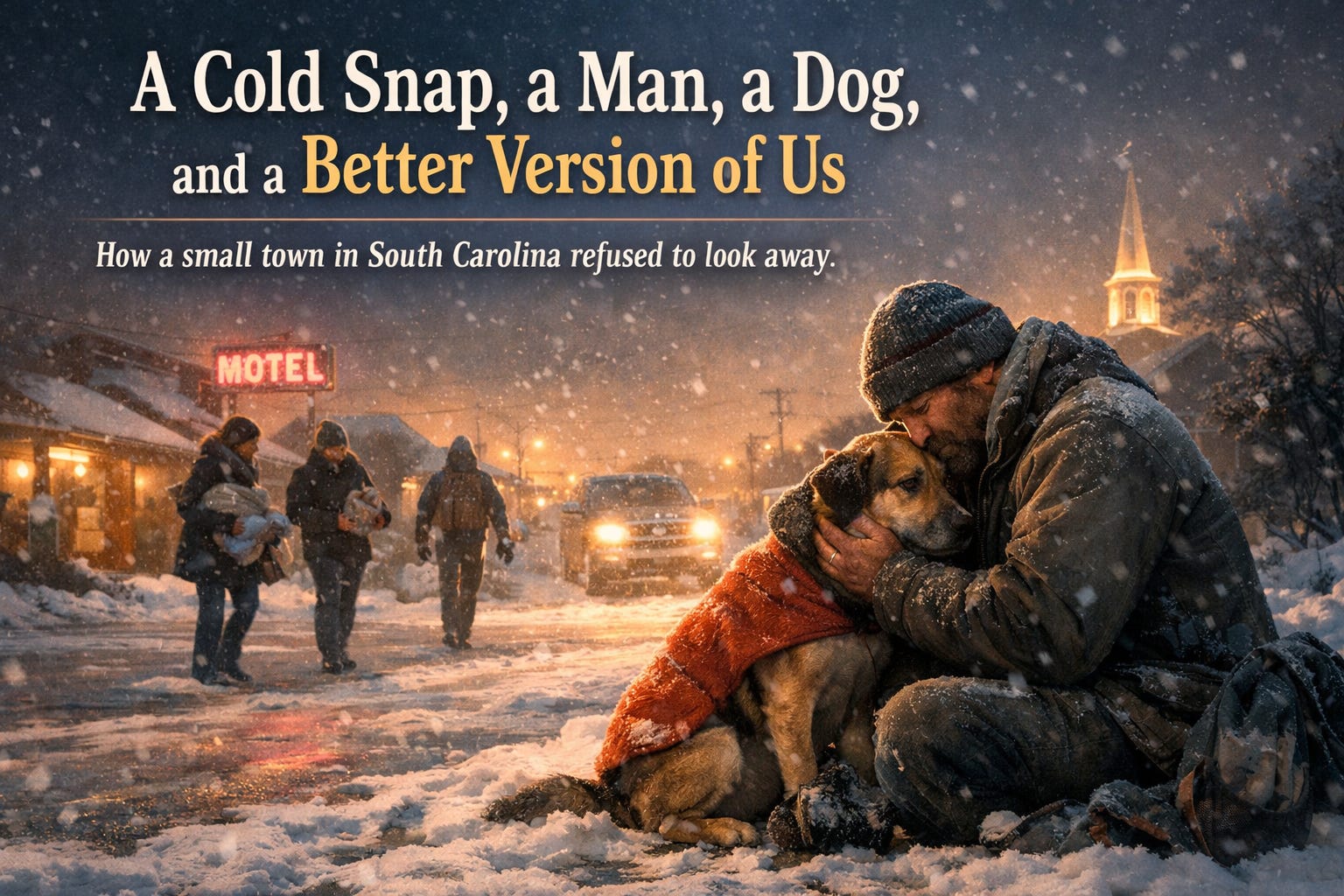
His name is Chris Brannon. He was unhoused, and had a dog with him named Mowgli. If you have ever known someone living outdoors, you know the math. The dog is not just a pet, the dog is family, protection, warmth, and the one creature who does not ask you to prove your worth before offering loyalty. Chris and Mowgli were out there when it was dangerous to be out there. This is usually where America’s story splits.
Version A is the story we are told we are trapped in. People scroll past, feel a pinch of guilt, and keep driving. Version B is the one we rarely hear about, because it doesn’t fit the cynicism machine. It also asks more of us than outrage, it asks for care. St. George chose Version B.
It started the way decent things often start now. Not with a formal organization or a polished campaign. It started with a person seeing something that did not sit right and refusing to let it be normal. A resident posted on Facebook asking for help for the man and his dog during the storm. And then the town did that old fashioned thing we keep insisting is dead. They acted like neighbors.
People went looking for Chris and Mowgli. They raised money for a hotel, they brought food, they delivered supplies, and they figured out the practical pieces, too. Who has a car that can handle bad roads, who has extra blankets, who knows where he might be staying, and who can coordinate. There were no grand speeches, no branding, no “look at me” performance. Just a chain reaction of humans refusing to let another human freeze.
I keep thinking about how small the original spark was. A post, a nudge, and a simple refusal to leave someone behind. “We are not going to be the kind of town that pretends not to see.” There is a reason stories like this hit so hard right now, they cut through the fog.
Most days, the cultural weather report is bleak. Polarization, loneliness, distrust, and cruelty turned into content. It is easy to start believing the worst version of ourselves is the truest one. It is easy to think we are sliding toward something colder, meaner, and more isolated.
And then a small town reminds you of something painfully obvious. Cynicism is not a law of nature, it is a habit, and habits can change. One detail from this story has been stuck in my head. An EMT helped bring a coat, not just for Chris, but for Mowgli, even though she herself was struggling. That is the part that people who love “every man for himself” logic cannot compute. If you are barely making it, why would you help someone else?
Because that is what being human is. Because suffering does not always produce selfishness, sometimes it produces recognition. Because we are not just individuals bouncing through the world alone. We are a network of obligations and tenderness, whether we admit it or not. This is the kind of thing we need to notice, not as a sentimental distraction, but as a compass. A lot of our public life is built around incentives. We reward what we praise, repeat what we amplify, and we teach people what matters by what we circulate.
Right now, we feed the algorithm a steady diet of the worst human behavior, then we act shocked when the culture starts tasting like it. So yes, we need to notice stories like St. George. We need to talk about them, the same way we talk about scandals and disasters. We need to treat kindness as newsworthy, not because it is cute, but because it is instructive. This was not a miracle, but rather a pattern of choices. A community responded quickly because they had a shared sense, however informal, of what you do when someone is in trouble.
That is what shared values look like in real life. Not slogans, yard signs, or hot takes. Shared values look like people coordinating rides in bad weather, like someone donating twenty dollars, someone handing over a spare blanket, or someone driving out when it would be easier to stay home. And if you want a glimpse of a better future that is not too far away, start here. The future is built out of these small decisions. The future is ordinary people deciding, again and again, that cruelty is not inevitable.
There is another thread here that matters. Chris was not just “helped” and then erased. The town did not treat him like a prop in their own hero story. They recognized him as a person, they saw his bond with his dog, they met the need in front of them without making it conditional on him becoming a different person first. That might be the most radical thing of all: help without a moral test.
Notice how rare that is. So much of our discourse comes with a whispered condition. “I will care about you if you have earned it,” “I will help if you make it easy for me,” or “I will show up if you do not complicate my narrative.”
But life is complicated, people are complicated, and need is complicated. The only way through is to practice generosity that does not wait for the world to simplify itself. Which brings me to the question that always hovers over a story like this. “Okay, but what does this change?” Chris is one man, and Mowgli is one dog, the world is still on fire. I get it. I feel it too.
But systems do not change because we finally become pure hearted angels who agree on everything. Systems change when the normal shifts, when the social default becomes: you notice, you act, you help. When the community expectation becomes: we do not leave people outside in a storm.
You can call that charity if you want, I prefer to call it training. It trains the heart, yes. It also trains the muscle memory of collective response, by building informal infrastructure that every better future needs. People who know how to mobilize, who can coordinate quickly, and people who fill gaps without needing a thousand meetings first.
And we should be honest. If towns can move that quickly for a storm, they can move that quickly for other kinds of storms, too. Housing, addiction, hunger, even loneliness. The slow-motion emergencies we have decided to tolerate. The point is not that this story solves everything, but it reveals what is still possible.
So yes, let’s reward this behavior. Let’s praise it without irony, let’s share it, let’s make it socially prestigious to be the kind of person who stops, who notices, who does not outsource compassion to “someone else.”
Because there is light, not just hypothetical, far away light either. It is already here, flickering in small places, waiting for us to pay attention long enough to make it spread. A small town in South Carolina saw a man and his dog in a storm and decided: not on our watch.
That is hope. Not the passive kind that waits for things to get better, but the active kind that makes better things happen. And we could do a lot worse than building a future out of that.
Thank you. I live in South Carolina and am very aware of the history of this state as well as the image we project to the world. I deeply appreciate how you have shared this story of community effort and care.
A beautiful story. Send it to AARP.