


My state senator, David Brock Smith, marked Martin Luther King Jr. Day, with an email. On its surface, it was polite, solemn, and familiar, an invocation of faith, freedom, public safety, and lawful change all in a whopping 147 words. But this wasn’t really about Dr. King at all. It was about something else entirely: how power explains itself in moments of strain.
For some perspective, Coos County offers a clear example of the political environment shaping this rhetoric. It voted for Donald Trump three times by wide margins, and in recent years even elected Rod Taylor, a local Christian nationalist who participated in the January 6 events, to the county commission. Taylor, who publicly scoffed at Juneteenth, openly celebrated Trump’s reelection prospects, suggesting the county’s chronic budget shortfalls could simply be washed away once Trump returned to power. That promise, like so many others, proved illusory. The budget woes remain, public services are still strained, and the gap between political loyalty and material reality continues to widen, a reminder that symbolic allegiance has never been a substitute for governance.
The email praised King’s “lawful and peaceful” pursuit of change within what the senator emphasized as our “constitutional republic,” carefully avoiding any mention of democracy. That omission is not neutral. In contemporary political language, “constitutional republic” is increasingly deployed to downplay majority rule and to suggest that democratic participation itself must be constrained for the system to remain legitimate. It reframes democracy not as a governing principle, but as a potential threat, something to be managed rather than expanded. This framing sits uneasily with Dr. King’s actual work, which centered on enfranchisement, voting rights, and the dismantling of systems designed to exclude people from political power. By affirming free speech and peaceful assembly only to pivot quickly into warnings about rioting, unlawful activity, and the need for accountability, the message further shifts attention away from state action and toward disciplining dissent. Police violence went unmentioned. Racial injustice was absent. Voter suppression, economic inequality, and the role of state power in enforcing those inequities were nowhere to be found, leaving a version of King’s legacy that demands obedience but not participation, order but not justice.
That kind of language functions as a barometer. When leaders feel unable, or unwilling, to defend what is happening in the present, they retreat into abstractions: order, lawfulness, public safety. They invoke revered figures like Dr. King while stripping their legacy of its sharpest truths. They begin, quietly, to normalize state violence by refusing to name it.
Understanding that pattern matters, especially now, because rural America helped elect Donald Trump. And rural political leadership, not just in Washington, but in statehouses across the country, plays an outsized role in shaping how power is justified, restrained, or unleashed.
To see where this leads, you have to go back to Selma. On March 7, 1965, roughly six hundred civil rights activists gathered in Selma, Alabama, to march to Montgomery. Their demand was not radical; it was constitutional. They were asking for the right to vote, a right denied to Black citizens through literacy tests, poll taxes, intimidation, and violence enforced by the state. The march was meant to expose that reality.
They never made it. As the marchers crossed the Edmund Pettus Bridge, they were met by Alabama state troopers and local deputies acting under orders to stop them. The protesters were unarmed, dressed in their Sunday best. Many were praying, and some carried American flags. Among them was a young John Lewis.
Without warning, the troopers advanced. Tear gas filled the air. Billy clubs came down on heads and backs. Mounted officers charged into the crowd. People were beaten, trampled, and gassed as they tried to flee. John Lewis suffered a fractured skull. Amelia Boynton Robinson was beaten unconscious; images of her body lying motionless on the bridge were broadcast across the nation.
This was not a riot as Smith might characterize it; it was state violence, deliberate, disciplined, and carried out under the authority of the law in the name of public safety. It became known as Bloody Sunday.
At the time, many officials responded the way leaders often do: condemning violence “on all sides,” urging calm, emphasizing order. Few named the troopers. Fewer named the system that sent them there. Justice only entered the conversation once the images made neutrality impossible.
That is the lesson so often lost when MLK Day is reduced to soft-focus platitudes. Dr. King was not asking the nation to admire its laws. He was asking it to confront when those laws became instruments of injustice. King was arrested repeatedly. Elected officials denounced him and he was accused of inciting disorder. In turn, he warned explicitly that appeals to “law and order” were often used to preserve injustice rather than correct it.
When contemporary leaders invoke King while emphasizing obedience and condemning unrest, without naming police violence, racial injustice, or voter suppression, they are attempting to neutralize his legacy. They are definitely not honoring it.
We are seeing the consequences of that now, as images emerge from Minneapolis and other cities where police violence has been exposed again and again. Once more, the focus from many in power is not on accountability, but on restraint. Not on justice, but on order. Protest becomes the danger, and somehow, magically, the state becomes the victim.
This is where rural political power matters. Rural America is not a caricature, but it is a political force. It elects sheriffs, legislators, governors, and presidents. It shapes the language through which authority is defended. When rural leaders signal comfort with abstraction and silence around state violence, that posture doesn’t stay local. It travels upward.
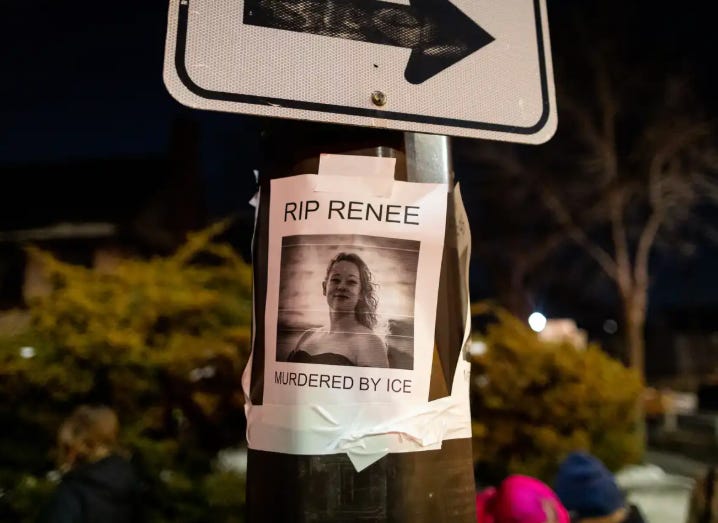
People like Renée Good, whose name does not appear in ceremonial emails, understood that civil liberties are not permanent. They are defended by sacrifice, often quietly, often at great cost. Her life belongs to the same moral lineage as those who crossed the Edmund Pettus Bridge: people who understood that justice is not maintained by order, but by accountability.
Those marchers in Selma did not sacrifice so that their legacy could be used to scold dissent. They sacrificed so the country would be forced to confront a harder truth: that law without justice is violence, and that peace without accountability is a lie.
Smith’s email doesn’t feel like someone wrestling with King’s legacy or speaking from conviction. It feels like an item checked off a calendar: MLK Day acknowledged, sentiments expressed, risks managed. At 147 words, it’s not an argument or a reflection; it’s a procedural gesture. An obligatory courtesy.
When remembrance becomes procedural, it loses moral content and gains political utility. The goal shifts from honoring the meaning of the day to controlling its implications. King is invoked not as a challenge to power, but as a means of insulating it.
That’s why the language is so careful and so thin. There’s no history, no names, no violence, no injustice, nothing that would require a position. Instead, we get abstractions that are safe to circulate in any climate: faith, order, lawfulness, public safety. It’s remembrance without risk.
The email isn’t just disappointing; it’s instructive. It shows how MLK Day functions for many officials now, not as a moment to confront the past or the present, but as a ritualized nod meant to close the book, not open it.
And when that kind of obligatory courtesy coincides with real-time state overreach, police violence, and democratic erosion, it becomes a quiet act of normalization.
When an elected official marks MLK Day without naming what Bloody Sunday actually was, or what it teaches us about power, it tells us something important about how they see the present moment. It tells us what they are preparing to justify.
"Soft focused platitudes" does not put food on the table, gas in the tank or pay the doctor's bills. Nor do those obligatory emails on the holiday rise to the importance of MLK's life and legacy, especially in times like these. "I have been to the mountaintop" was not a platitude, it was a prophecy. MLK was not just a leader of a movement, he was a Christ-like figure who walked among us and, like Jesus, we murdered him. The "we" I speak of is the strain of white nationalism that has always run through this country but had thinned out before the internet and through many protests, marches, letter-writing and good trouble, but mostly by changing and adding laws. We know that people won't change (unless it is easy, like a shot to lose weight), so the institutions and the objects must be changed to make us safe. When those changes are in the hands of madmen and Nazis, no one is safe.
Send his message to Reader’s Digest or Hallmark to see if it needs to be shortened … add some sparkle ✨