

Good morning! Standing in the residence of the American ambassador in Dublin on Saturday, Donald Trump told the room he loved Ireland because of its people. “You have unbelievable people in Ireland,” he said. He meant it as a compliment. That same afternoon, he flew west to watch the Irish Open at his own golf course in Doonbeg, where two demonstrators had already made their way onto the seventh green. One lay down on the grass. Security moved in; the protester went limp, and officers were left dragging them off the fairway while play continued around them. It was one scene among several from that weekend; placards reading “no red carpet for Trump” lining the road out of Shannon Airport, thousands more behind barricades in Dublin waving Irish, Palestinian, and Iranian flags, a man in an inflatable Trump-baby costume telling a camera crew he couldn’t understand “why we’re welcoming him here in the first place.” Unbelievable people, indeed.
I’ll admit to more than a little ancestral pride.
The more consequential story from Trump’s weekend in Ireland may not have been the people loudly refusing to play along.
It was the growing evidence that some of the people still smiling for the photographs, shaking his hand and calling the United States an indispensable friend have quietly begun making plans for a world in which they will not have to depend upon it quite so much.
There were, rather wonderfully, two $21 trillions floating around this week.
Speaking at the American ambassador’s residence in Dublin, Trump announced that nearly $21 trillion had been invested in the United States during his first 16 months back in office. “We’re at almost $21 trillion in 16 months,” he said. “No country’s ever done that or close to it.”
FactCheck.org had examined essentially the same claim just three days earlier, when the number was still only $20 trillion. The White House’s own investment page lists about $11.2 trillion, and even that figure includes domestic projects unrelated to Trump, announcements spread across years or decades, and pledges that may never become actual investment. Commerce Department foreign-investment data show nothing remotely approaching Trump’s total.
The missing trillion arrived somewhere over the Atlantic.
Another $21 trillion appeared in the Wall Street Journal.
That is roughly the size of the European Union’s existing single market, the one Mark Carney’s government is now exploring ways to plug Canada much more deeply into through defence, energy, critical minerals, artificial intelligence, research and strategic supply chains. Canadian goods, services and perhaps eventually workers in certain sectors could move with far less friction between Canada and Europe. Officials are discussing undersea cables, data centers, cloud storage, satellite networks and energy infrastructure designed in part to reduce dependence on American systems.
Same number. Same week.
One was a presidential claim whose supporting arithmetic comes nowhere close to the total.
The other is a market that already exists.
Welcome back to Trumperbole.
We have used that word before to describe Trump’s peculiar form of rhetorical inflation, in which something does not merely become bigger with each retelling; repetition itself seems expected to transform assertion into reality. Ten trillion becomes eighteen, eighteen becomes twenty, twenty becomes twenty-one. Eventually the number is no longer being asked to describe anything. Its job is to occupy the space where evidence ordinarily goes.
Ireland supplied several additional examples.
The Irish, Trump told a room full of Irish officials and business leaders, had “fleeced” America by taking its pharmaceutical companies.
“You took all of our medical companies,” he said. “We got to get a couple of them back. You people did very well. You fleeced us, but that’s okay.”
Then, almost without taking a breath, he assured them that the relationship was “fantastic.”
There is an entire theory of international economics hiding in those few sentences, although possibly not one you would want teaching the graduate seminar.
American pharmaceutical companies chose to invest in Ireland for access to the European market, a skilled English-speaking workforce, favorable tax treatment and a life-sciences ecosystem that successive Irish governments deliberately built. Ireland does not independently negotiate trade agreements with the United States; trade policy is handled through the European Union.
But in Trumperbole, capital allocation becomes theft.
Ireland has something America used to have. Therefore Ireland took it.
A similarly complicated compression occurred when Trump was asked about Irish reunification.
“I’d love to see it unified,” he said. If reunification is eventually going to happen, he reasoned, “it may as well happen now.” Later, at the ambassador’s residence, he called the idea “very cool.”
This produced an unusual political achievement: nationalists and unionists found themselves disagreeing about practically everything except the proposition that Donald Trump does not get to decide this.
Sinn Féin welcomed his support for reunification. The Democratic Unionist Party replied that Northern Ireland’s future would be decided by the people of Northern Ireland, not by commentary from Washington, London or Dublin. The Irish government returned to the long-term process contemplated by the Good Friday Agreement. Downing Street did the same.
Even nationalist politicians who want a united Ireland treated Trump’s intervention with considerable caution. Matthew O’Toole of the SDLP said that advocates of unity still had to be “responsible and serious” about how it would happen rather than assuming it simply would.
The Good Friday Agreement was painstakingly constructed around consent precisely because “it’ll probably happen eventually, so why not now?” is not an adequate constitutional process.
Then there was NATO.
Trump complained that allies had declined to join the American operation in the Strait of Hormuz and wondered aloud, “why the hell are we helping them?”
Except NATO Secretary General Mark Rutte has repeatedly pointed out the rather important technical detail that Iran and Hormuz are outside NATO territory. European allies have nevertheless contributed extensive capabilities through other arrangements, including British- and French-led work on demining and freedom of navigation.
Again, a complex alliance structure collapses into a personal transaction.
It is mob-boss diplomacy stripped of the violin case: we helped you; you did not do what I wanted, so why should we keep helping you? More revealingly, it is a worldview in which systems seem legitimate only when they deliver the outcome expected by the person at the center.
Then came Pat Leahy of the Irish Times with perhaps the most useful observation of the weekend.
Trump, he noted, was in Ireland for two days and was there mainly to watch golf. The Irish Open happened to be taking place at Trump International Golf Links & Hotel Doonbeg, a business owned by Trump’s family. In Leahy’s assessment, “the main purpose of this visit seems to be a promotional visit for a Trump business.”
The bilateral meetings were real, but the itinerary was built around a globally televised sporting event at a resort carrying the president’s name.
At the end of his diplomatic speech, after discussing trade, NATO, Iran, immigration, crime, Venezuela, Joe Biden, Kamala Harris and the allegedly rigged 2020 election, Trump announced that he was heading to Doonbeg to watch Shane Lowry and Rory McIlroy.
Official business concluded. Back to golf.
While Trump was turning diplomacy into content in Ireland, the boring people were working. Two days before Trump stood in Dublin describing a missile interception no one else can confirm, Mark Carney welcomed Volodymyr Zelenskyy to Calgary; Zelenskyy’s fifth visit to Canada, his third meeting with Carney on Canadian soil. The Canadian message was: you know more about this than we do. Teach us.
The new Defence Drone Initiative Marketplace, a national digital exchange meant to connect the Canadian military to nearly 400 vetted domestic suppliers, is explicitly modeled on Brave1, the coordination platform Ukraine built to fast-track wartime innovation under fire. Ottawa isn’t pretending to have invented anything. It’s copying the homework of the country that learned drone warfare by necessity, and saying so out loud. Canada’s own inventory currently sits at 2,000 drones, of every type combined; the stated goal is to produce millions within two years, by combining battlefield lessons Ukraine has already paid for with Canadian manufacturing, software, and AI.
Zelenskyy supplied the detail that makes the method visible. Describing the co-production timeline, he said his own teams first proposed ninety days. “Then Mark said, can we have it in nine days?” Zelenskyy recalled. “And the teams immediately said, ‘Yes, of course.’” It wasn’t just a good line; Ottawa’s own account confirms the pattern: the Defence Drone Initiative went from launch to its first signed contract in fifty days. Nobody held a rally about it.
The same governing method appears at much larger scale in what Ottawa has been quietly building with Europe.
The Journal reports that after trade negotiations with Washington deteriorated, Carney accelerated discussions he had already been holding with European leaders about moving Canada closer to the European Union, not as a full member, but through something potentially unprecedented that he has floated as “Associate Member of the European Union.”
The label may never survive, but the substance is moving along.
Carney’s team mapped 36 different functions countries perform for one another; intelligence sharing, regulatory cooperation and assorted other bits of governmental plumbing, then studied the arrangements Britain, Norway, Switzerland and others have with the European Union to see where Canada could connect more deeply.
Defence. Energy. AI. Critical minerals. Research. Data. Supply chains. Canada is building options and not just complaining about the United States.
In February, at the Munich Security Conference, Canada signed an agreement making it the first non-European country to participate in the EU’s SAFE defence-procurement instrument; the EU Council formally concluded the agreement in June, allowing Canadian companies and products to participate in a European system designed to finance joint military procurement and expand the continent’s defence-industrial capacity.
Canadian and European officials have also drawn up what they call “11 stack items” for deeper cooperation and reduced dependence on American technology, defence equipment and trade. French officials told the Journal they were startled by how rapidly Ottawa wanted to move.
One Canadian official involved in the talks gave the Journal perhaps the best description of the whole enterprise: “tectonic change by working groups and bureaucracy,” terribly unsexy, but terribly consequential.
Which brings us to possibly my favorite juxtaposition of the week.
As Trump was signing an executive order renaming Lake Ontario “Lake America,” Canadian diplomats were in Berlin holding meetings on defence cooperation.
Around the same time, Trump posted an AI-generated image of himself looming over Carney with a hockey stick and a speech bubble telling “Governor” Carney to “get up.”
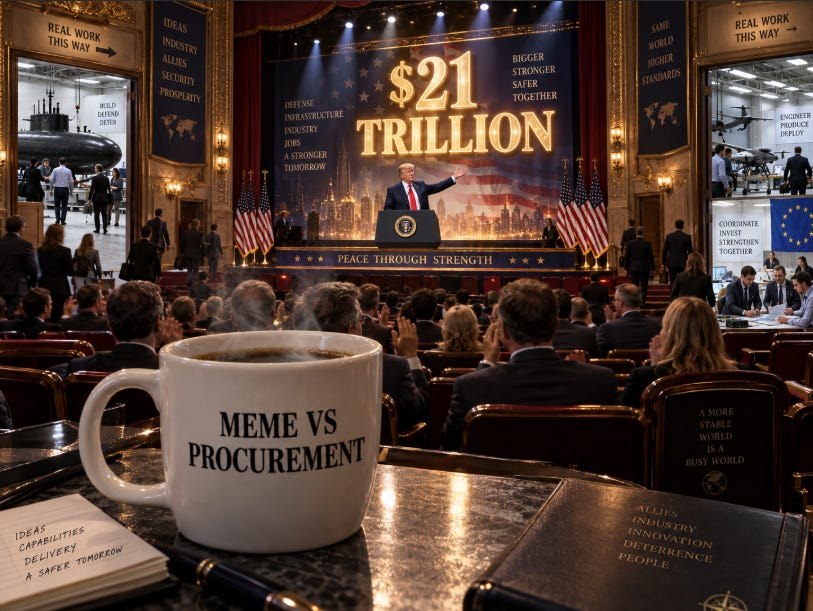
All the while, Carney was completing negotiations for Canada’s $25 billion purchase of German-Norwegian submarines. Think of it as meme versus procurement.
This is where our old kayfabe problem develops a second act.
Kayfabe works only as long as the audience agrees, at least temporarily, to inhabit the performance. A threat carries force because others react to it; a boast matters because the room accepts its premise.
The more interesting question is what happens when some of the people in the ring quietly stop playing along.
Open defiance would be costly, so the rituals continue: meetings are attended, hands shaken, friendships reaffirmed, phone calls returned, even as some of the consequential decisions begin moving elsewhere.
That is asymmetric disengagement.
Canada does not need to hold a press conference announcing that the “Governor” joke failed. It can join SAFE.
Europe does not have to announce that it no longer trusts American technology infrastructure. Officials can simply begin discussing European-Canadian cables, data centers and cloud systems.
Canada does not have to rebut claims about American military supremacy. It can buy submarines from Germany and Norway and build drones with Ukrainians.
European allies do not need to win an argument about Hormuz inside NATO. Britain and France can organize capabilities outside NATO’s formal structure when NATO is not the applicable institution.
Nothing ruptures. It accretes.
The first problem with Trumperbole is epistemological: the statement may simply not be true.
Twenty-one trillion dollars has not materialized merely because the number was spoken aloud.
The second problem is strategic: other actors can begin making decisions based on reality without requiring the person making the claim ever to concede that reality exists.
We have seen the other version too.
In April 2025, Trump’s sweeping tariff program collided with financial markets. Stocks fell. U.S. government debt sold off. Investors began openly worrying about financial instability. Trump abruptly paused most of the tariffs for 90 days. The Financial Times reported that market turmoil and the Treasury selloff were among the forces pressing on the administration as it retreated.
That was a sharp collision with epistemic reality. Markets do not have to smile politely during the bilateral meeting. They simply reprice, and when they do it all at once, everybody can see the result.
The slower version we are watching now may be more consequential precisely because it never produces that moment.
There is no ticker showing AMERICAN STRATEGIC LEVERAGE DOWN 4.7% TODAY.
Canada joins SAFE. It buys a submarine somewhere else, builds a drone factory with Ukraine, signs a critical-minerals agreement, lays a cable, qualifies a company as a European supplier. Students start moving through another exchange program, scientists through another research network, natural gas through another terminal.
None of these decisions announces the end of anything. But each changes the answer, just a little, to the question underlying so much of Trump’s diplomacy: What choice do you have? Several.
Perhaps the most extraordinary detail in the entire Wall Street Journal investigation is that the scale of Canada’s negotiations with Europe has “barely registered in the White House.” That may be the danger hidden inside Trumperbole.
A bond market can punish Trumperbole in an afternoon, and the feedback arrives fast enough to force a policy change. Alliances reroute differently: they can smile, shake hands, and repeat the old assurances, all while the next procurement decision gets made somewhere else. The performance never has to collapse. It can go on working perfectly well for the audience still watching it: a lake gets renamed, a meme posts, $21 trillion gets announced, the applause continues, and every scene ends with the protagonist standing triumphantly at center stage.
Somewhere off-camera, people with spreadsheets are changing the wiring. The sharp collision corrects the performer, while the slow one quietly corrects the world around him.
What the world could be like if military might wasn't required.
The hand might not be quicker than the mouth, but it builds a more solid road.